


Does MMA have belts, and what are the belt levels? It's a common question from new students, and the honest answer has two parts. Professional MMA has no belt ranks, and no single belt system covers every gym. But belts still turn up all over MMA training: one of the sport's international amateur federations runs its own grading scheme, and several of the arts that make up MMA have a belt or armband order of their own. Here is each one, in order, with the colors.
MMA belt order and colors
There isn't one MMA belt order. These are the ones you'll actually come across, each listed from the first belt to the last:
| Where it's used | Belts, first to last |
|---|---|
| Amateur MMA (IMMAF grading) | Yellow, orange, green, blue, purple, brown, black |
| Brazilian jiu-jitsu, adults | White, blue, purple, brown, black |
| Brazilian jiu-jitsu, kids 4–15 | White, grey, yellow, orange, green |
| ITF Taekwon-Do | White, yellow, green, blue, red, black |
| Karate and judo | Set by each school or organization; typically white first and brown last before black |
| Muay Thai | No rank belts; many gyms outside Thailand rank with colored armbands in their own order, usually starting with white |
| Boxing and wrestling | Traditionally no rank belts |
| Professional MMA | No rank belts; a "belt" is a championship title |
Amateur MMA: the IMMAF grading belts
MMA does have one well-documented belt system: the grading scheme the International Mixed Martial Arts Federation (IMMAF) runs for amateur MMA. It has six main belts, in this order: yellow, orange, green, blue, purple and brown, plus six intermediate grades. A black belt sits at the top and is open only to athletes aged 18 and over. IMMAF's own explainer gives a minimum of one year at each grade, and only IMMAF-certified coaches can run gradings.


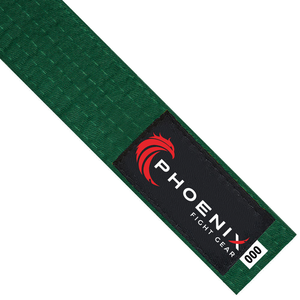
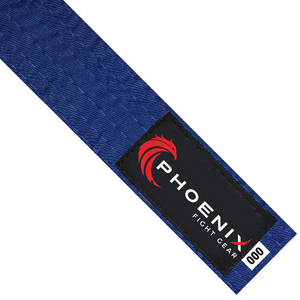
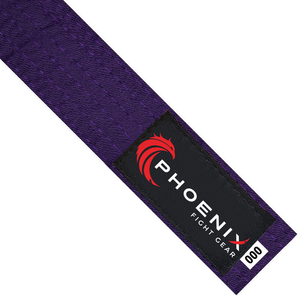
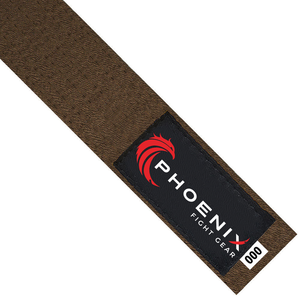
IMMAF grading colors in order, shown with our solid-color rank belts. Black follows at 18 and over.
The scheme is built for youth and amateur MMA. IMMAF's guidance for young beginners adds a white grade before yellow, and athletes need a minimum grade to enter its youth and junior championships. It is not a rule of the sport as a whole: professional promotions don't rank fighters by belt, and other federations and gyms are free to use their own ranks or none at all.
Brazilian jiu-jitsu belt order: adults
Brazilian jiu-jitsu (BJJ) is a core part of MMA's ground game, and its adult belt order is short: white, blue, purple, brown, black. Under the International Brazilian Jiu-Jitsu Federation (IBJJF) system, the minimum age is 16 for blue and purple and 18 for brown. Black belt requires a year at brown, which makes it 19 in practice; the one exception is an adult world champion at brown belt, who can be promoted at 18.
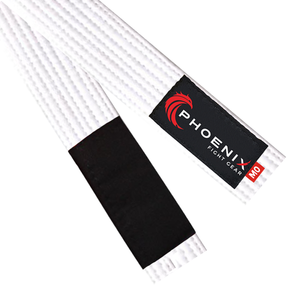
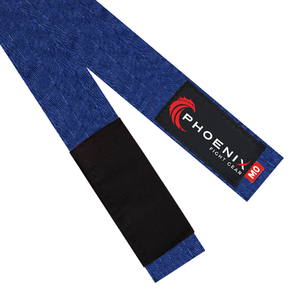
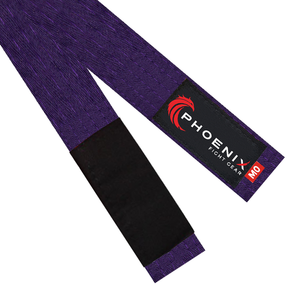
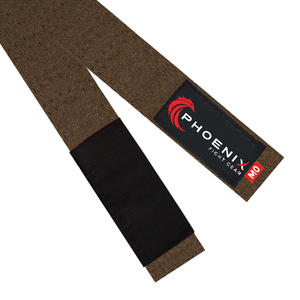
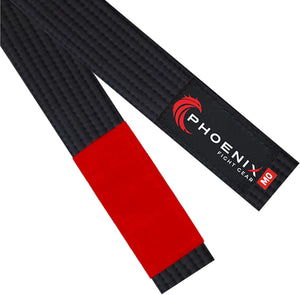
The five adult BJJ belts in order.
Many academies also award up to four stripes on each belt below black along the way. Our guide to the BJJ belt ranking system covers every belt in detail, including the coral and red belts beyond black.
Brazilian jiu-jitsu belt order: kids
Athletes aged 4 to 15 follow their own IBJJF track between white and blue: grey, yellow, orange and green, each in three steps — with a white stripe, solid, then with a black stripe. Counting white, that makes 13 kids belts, and each color group opens at a set age.
| Belt group | Belts, first to last |
|---|---|
|
White first belt |
 White White |
|
Grey from age 4 |
 Grey/ Grey/ Grey Grey  Grey/ Grey/ |
|
Yellow from age 7 |
 Yellow/ Yellow/ Yellow Yellow  Yellow/ Yellow/ |
|
Orange from age 10 |
 Orange/ Orange/ Orange Orange  Orange/ Orange/ |
|
Green from age 13 |
 Green/ Green/ Green Green  Green/ Green/ |
In the year they turn 16, young athletes move onto the adult track. We carry all 17 belts, kids and adult, in our BJJ belts collection.
Karate, taekwondo and judo belt colors
These arts all use colored belts on the way to black belt, but there is no single order. Each school or organization picks its own colors and sequence, so the order at one school can differ from the one at the school down the road. In karate and judo, white is typically the first belt and brown the last before black. One example with a fixed order is the International Taekwon-Do Federation (ITF), which runs white, yellow, green, blue, red, black, with a tipped belt between each color and the next.
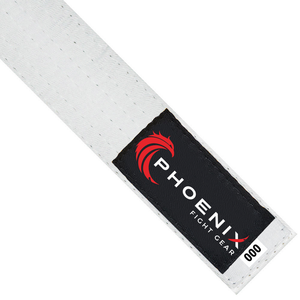
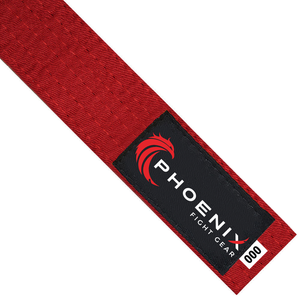
ITF Taekwon-Do color belts in order. Black comes next.
If your school uses colored rank belts, follow its chart. You'll find solid and two-color belts for those systems in our martial arts belts collection.
Muay Thai ranks: armbands, not belts
Traditional Muay Thai has no rank belts. In Thailand a fighter's standing has traditionally come from results in the ring, not from a rank. What the art does have is the prajiad (also spelled pra jiad or prajioud), a cloth armband tied around the upper arm. By tradition it is worn for good luck, not to show rank.
Many gyms outside Thailand have turned the armband into a ranking system, with a new color at each level, much as other arts use belts. Colors and order are up to the gym or association, and white is the usual starting point. One order in use runs white, yellow, orange, green, blue, purple, red, brown, black.
One armband order used at some Muay Thai gyms. Yours may differ.
Many schools call their levels Khan grades (khan is Thai for grade or level). In one published version, the ten student grades run white, yellow, green, blue, brown, red, with a half-white grade after each color from yellow to brown (yellow/white, green/white and so on). Instructor grades sit above red. Depending on the school, the color is worn on the armband or on the mongkol, the traditional headband.
Khan grades 1 to 10 in this version.
In April 2025 the International Federation of Muaythai Associations (IFMA), the sport's IOC-recognized federation, launched an updated, standardized 15-level Khan grading system and said a minimum Khan level will be required to compete in IFMA-sanctioned competitions. Its announcement does not list colors. Your gym may follow that system, use its own armband colors or have no ranks at all; go by what your coach uses.
For training, we carry Muay Thai shorts, Thai pads and boxing gloves.


Each photo links to its collection.
No rank belts: boxing and wrestling
Boxing and wrestling traditionally have no rank belts; progress shows in competition results.
Championship belts are something else
In professional MMA, "the belt" means a title. Promotions such as the UFC award a championship belt to the champion of each weight class. It is a prize to win and defend, not a rank you train toward.
Why MMA doesn't have standardized belts
Mixed martial arts is exactly what the name says: a mix. It draws from Brazilian jiu-jitsu, wrestling, boxing, Muay Thai, judo, karate, taekwondo and more — and those arts handle ranking completely differently. BJJ uses five adult belts earned over many years; boxing and wrestling traditionally use none; Muay Thai gyms that rank students often use armbands; karate and taekwondo schools set their own colors. With its component arts split on the very idea of ranking, MMA grew up without a belt ladder of its own. The professional side still has none: in pro MMA, you are ranked on results, not by belt. The IMMAF grading scheme is a newer addition on the amateur side.
Where you WILL see belts in MMA training
Belts show up inside MMA gyms in four ways. First, many MMA athletes hold rank in a component art — a fighter may be a BJJ purple belt or a judo black belt, and that rank is real and earned within that art's system. Second, clubs with IMMAF-certified coaches can grade their students through the IMMAF belts. Third, some MMA schools run their own internal ranking programs to give students milestones — these are legitimate within the school that runs them, but they aren't standardized between schools. Fourth, many kids MMA programs use belt or stripe systems, because young athletes thrive on visible progress.
What to make of it as a student
If your gym uses ranks, respect its system — consistency inside a school matters more than standardization between schools. If it doesn't, your progress shows up in other ways: rounds survived, techniques landed and how you handle sparring. Either way, what every MMA student actually needs is the right equipment for the mix of ranges you train in: MMA gloves with an open palm for grappling, sparring headgear, shin guards for the striking rounds and a rash guard for the grappling ones. For young athletes, our kids sparring gear collection has MMA gloves, headgear and shin guards in youth sizes.
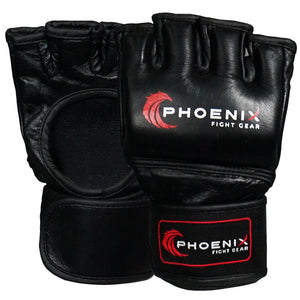



Each photo links to its collection.
Training in a belted art alongside MMA? Phoenix Fight Gear carries IBJJF approved BJJ belts, plus karate and taekwondo rank belts in 28 colors — designed by martial artists who've spent four decades on the mats.